
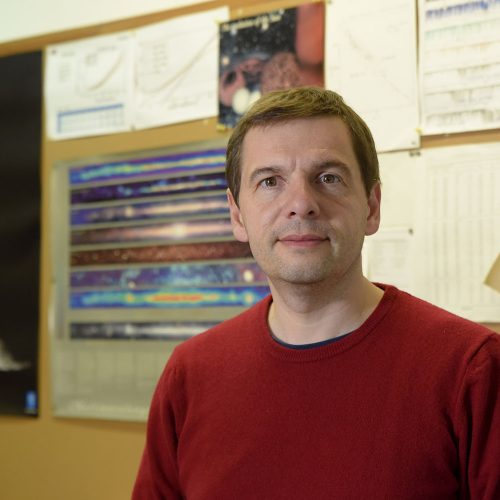
Nuno C. Santos é professor Auxiliar com Agregação no Departamento de Física e Astronomia/Faculdade de Ciências da Universidade do Porto. Completou a licenciatura em Física na Faculdade de Ciências da Universidade de Lisboa (1996) e o mestrado em Astronomia e Astrofísica na mesma Universidade (1998). Em 2002 terminou o doutoramento na Universidade de Genebra/Observatoire de Genève, Suíça, sob supervisão do Prof. Michel Mayor (Prémio Nobel da Física em 2019), instituição onde realizou o seu primeiro pós-doutoramento. Em 2003 regressou a Portugal para integrar o CAAUL e mais tarde o CAUP (2007), instituições que formaram o IA (2015).
Os principais interesses de investigação atuais focam-se na procura e estudo de exoplanetas, sendo atualmente líder da linha temática “Towards the detection and characterization of other Earths” no IA. Autor de mais de 300 artigos em revistas de grande impacto, Nuno C. Santos tem trabalhos de grande relevância publicados na pesquisa de exoplanetas utilizando métodos de velocidades radiais e trânsitos, sobre o estudo da relação estrela-planeta, e sobre o estudo de atmosferas de exoplanetas. Nestes destaca-se a descoberta, em 2004, do primeiro exoplaneta potencialmente rochoso a orbitar uma estrela de tipo solar, e de estudos pioneiros sobre a relação entre a composição química das estrelas e a frequência/composição dos planetas que ela orbitam. Estes últimos estudos levaram-no a ganhar, em 2010, o prémio internacional Viktor Ambartsumian (em conjunto com o Prof. Michel Mayor e Prof. Garik Israelian).
No contexto da sua investigação está envolvido em vários projetos para construção de instrumentos e missões espaciais, incluindo: coinvestigador Responsável do projeto ESPRESSO (ESO), coinvestigador do projeto NIRPS (ESO), membro do board das missões CHEOPS e PLATO (ESA), e membro do Steering Committee do instrumento HIRES para o ELT.
Nuno C. Santos is Associate Professor with Habilitation at the Department of Physics and Astronomy of the Faculty of Sciences of the University of Porto. He graduated in Physics from the Faculty of Sciences of the University of Lisbon in 1996 and obtained a Master’s degree in Astronomy and Astrophysics from the same institution in 1998. In 2002, he completed his PhD at the University of Geneva/Observatoire de Genève, Switzerland, under the supervision of Professor Michel Mayor, recipient of the 2019 Nobel Prize in Physics, where he also carried out his first postdoctoral research.
His current research focuses on the detection and characterisation of exoplanets, and he leads the thematic line “Towards the Detection and Characterisation of Other Earths” at the Institute of Astrophysics and Space Sciences (IA). He is the author of more than 300 papers published in leading scientific journals and has made significant contributions to exoplanet research using radial velocity and transit methods, the study of star–planet relationships, and the characterisation of exoplanet atmospheres.
Among his most notable achievements is the discovery, in 2004, of the first potentially rocky exoplanet orbiting a Sun-like star, as well as pioneering studies on the relationship between stellar chemical composition and the frequency and composition of orbiting planets. This work led to the award of the Viktor Ambartsumian International Prize in 2010, jointly with Professors Michel Mayor and Garik Israelian.
As part of his research activities, he is involved in several instrument development projects and space missions, including serving as Co-Principal Investigator of the ESPRESSO project (ESO), Co-Investigator of the NIRPS project (ESO), member of the boards of the CHEOPS and PLATO missions (ESA), and member of the steering committee of the HIRES instrument for the ELT.
Sessão/ Session: Liderar pelo Conhecimento: Portugal e o Programa Científico da ESA / Leading Through Knowledge: Portugal and ESA’s Science Programme
